Nepenthes eustachya
About
A climbing, tropical species, *Nepenthes eustachya* is notable for its distinct morphology, including a lanceolate lamina with a rounded to sub-peltate apex and lower pitchers that bear a simple or bifurcate spur. It is endemic to the Indonesian provinces of North and West Sumatra.
Field notes
Morphology
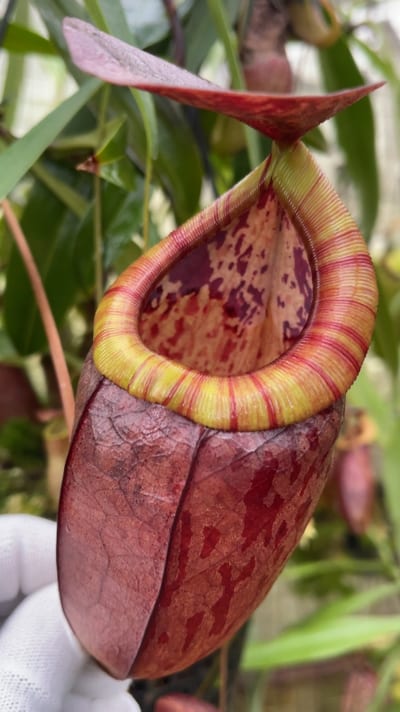
The plant is a climbing species with stems reaching up to 5 m and internodes up to 12 cm. Leaves are coriaceous and petiolate, with laminae up to 20 cm long and 5 cm wide, featuring a rounded to emarginate apex. Lower pitchers are ovoid in the lowermost quarter and cylindrical above, reaching up to 20 cm high and 4 cm wide; they lack wings and bear a pair of ribs. The peristome is usually yellowish and may bear red stripes, and the lid is sub-orbicular. Pitchers are white to light pink with many red speckles.
Distribution & habitat
Endemic to the Indonesian provinces of North Sumatra and West Sumatra, ranging from sea level to an elevation of 1,600 m.
History & etymology
Described in 1858 by Friedrich Miquel. The specific epithet eustachya is derived from the Greek words eu (true) and stachys (spike), referring to the racemose structure of the inflorescence. It was first collected in February 1856 by Johannes Elias Teijsmann.
Conservation
Least Concern (IUCN 2006 Red List)
Habitat
- Altitude
- 0–1,600 m
- Altitude class
- intermediate
- Native to
- Sumatra
- IUCN status
- Least Concern
Taxonomy
- Described
- 1858
- Authority
- Miq.
Cultivation
- Difficulty
- intermediate