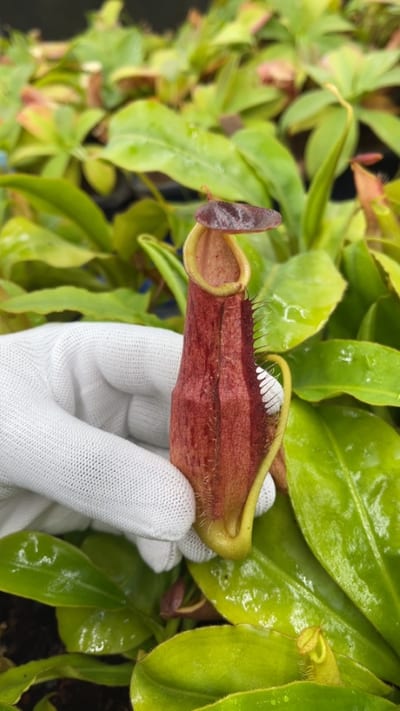
Nepenthes longifolia
About
A notable climber, *Nepenthes longifolia* is characterized by its exceptionally large leaves and robust growth habit, often reaching lengths of up to 55 cm. It is a species of Sumatra, known for its diverse pitcher morphology depending on whether it is a lower or upper pitcher.
Field notes
Morphology
The plant is a strong climber with stems that can reach 10 to 12 m in length. Leaves are coriaceous, lanceolate to lanceolate-spathulate, up to 55 cm long and 9 cm wide, with an emarginate apex. Lower pitchers are ventricose or narrowly ovoid, growing up to 20 cm high and 5 cm wide, featuring a flattened peristome up to 6 mm wide and a distinct raised section. Upper pitchers are larger, growing to 25 cm in height and 4 cm in width, and possess a characteristically crumpled peristome with three prominent folds.
Distribution & habitat
Endemic to Sumatra, specifically found in West Sumatra and North Sumatra. It thrives at elevations between 300 and 1,100 m above sea level.
History & etymology
The specific epithet longifolia is derived from the Latin words longus (long) and folius (leaf), referring to the species' large leaves. The first known collection was made by Willem Meijer in 1957. Joachim Nerz and Andreas Wistuba formally described Nepenthes longifolia in 1994.
Habitat
- Altitude
- 300–1,100 m
- Altitude class
- intermediate
- Native to
- Sumatra, Indonesia, Malaysia
- IUCN status
- Least Concern
Taxonomy
- Described
- 1994
- Authority
- Nerz & Wistuba
Cultivation
- Difficulty
- intermediate
- Temperature
- Day 22–30°C / Night 15–22°C
- Humidity
- 70–95%