Nepenthes maxima
About
Nepenthes maxima, the great pitcher-plant, is a carnivorous species of the genus *Nepenthes*. It is known for its impressive pitchers and wide variability across its range.
Field notes
Morphology
The species exhibits great variability in its pitchers, with plants in drier areas producing elongated pitchers that have narrow peristomes and well-developed waxy zones. Conversely, those in perhumid areas often feature a reduced waxy zone and an enlarged peristome. Some forms, particularly those from Sulawesi, can display distinctly wavy laminar margins, and in extreme cases, the leaf wings may be highly undulate.
Distribution & habitat
It has a relatively wide distribution covering New Guinea, Sulawesi, and the Maluku Islands. It may also be found on Wowoni Island.
Ecology
As a carnivorous plant, Nepenthes maxima captures prey using its pitchers. The effectiveness of the trapping mechanism varies based on environmental conditions, with the peristome being more effective at trapping prey when fully wetted, but the waxy zone being more effective in drier conditions.
History & etymology
The species name Nepenthes maxima comes from the Latin word 'maximus,' meaning 'greatest.' It belongs to the loosely defined 'N. maxima complex,' which includes several related species.
Conservation
Assessed as Least Concern (LC) on the IUCN Red List.
Habitat
- Altitude
- 40–2,600 m
- Altitude class
- intermediate
- Native to
- Indonesia, Papua New Guinea
- IUCN status
- Least Concern
Taxonomy
- Described
- 1824
- Authority
- Reinw. ex Nees
Cultivation
- Difficulty
- intermediate
- Temperature
- Day 22–30°C / Night 15–22°C
- Humidity
- 70–90%
Borneo Exotics 7 listings
View all → BE-3786N. maxima - wavy leaf - clone #9
 BE-3907N. maxima – wavy leaf - clone #1
 BE-4081N. maxima - Sulawesi wavy-leaf – assorted clones
 BE-3709N. maxima x ‘trusmadiensis’ - selected clones
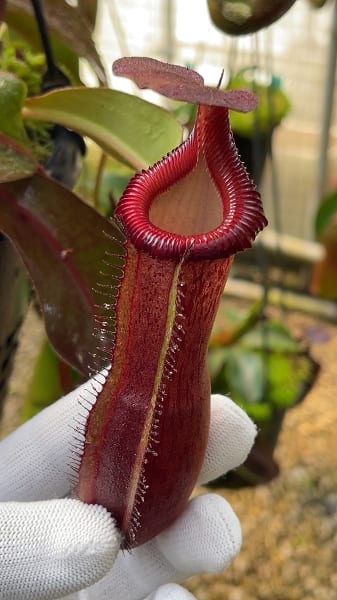 BE-4678N. {[(lowii x veitchii) x boschiana] x [(veitchii x maxima) x veitchii]} x edwardsiana - clone # 3
 BE-3740N. maxima x ramispina – best selected clone
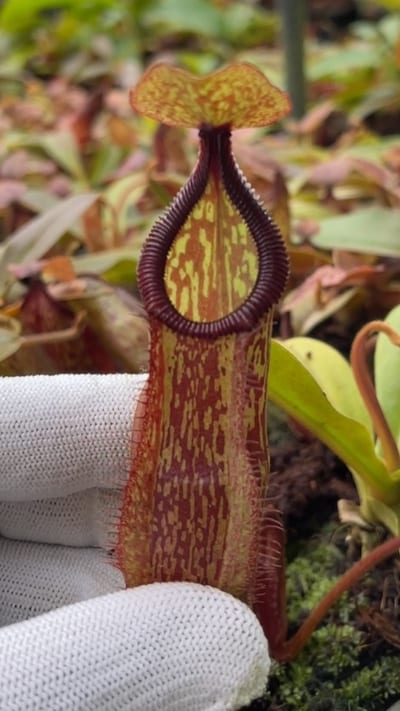 BE-4689N. hamata x maxima - assorted clones