Nepenthes Robcantleyi
About
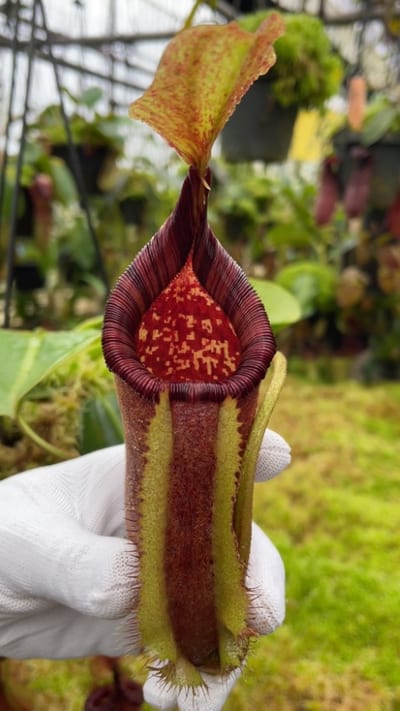
A striking tropical species, *Nepenthes robcantleyi* is notable for its exceptionally large pitchers, which can reach up to 33 cm high by 9.5 cm wide. It is a robust, shrubby plant that was initially mistaken for a highland variant of *N. truncata*.
Field notes
Morphology
The plant is a shrub growing to 0.5–1 m, with a terete stem reaching around 2 cm in diameter. Leaves are thick, coriaceous, and oblong-elliptic, with a pronounced petiole that can reach 23 cm in length. Mature pitchers are broadly cylindrical, measuring up to 33.0 cm high by 9.5 cm wide.
Distribution & habitat
Endemic to the Philippine island of Mindanao.
Cultivation notes
The species is reported to be an easy grower and does well in typical Nepenthes highland conditions, requiring warm days up to 25 °C, cool nights down to 12 °C, and high light levels. A pitcher-to-leaf size ratio greater than 1 can be achieved in cultivation.
History & etymology
Discovered by Robert Cantley in January 1997 on Mindanao. The specific epithet robcantleyi was chosen to honour Robert Cantley, avoiding confusion with the previously used, invalid name N. × cantleyi.
Conservation
Assessed as Endangered (EN) on the IUCN Red List.
Habitat
- Altitude
- 1,800–1,800 m
- Altitude class
- highland
- Native to
- Borneo
- IUCN status
- Critically Endangered
Taxonomy
- Described
- 2011
- Authority
- Cheek
Cultivation
- Difficulty
- expert
- Temperature
- Day 18–25°C / Night 10–18°C
- Humidity
- 70–95%
Borneo Exotics 20 listings
View all → BE-4038N. burbidgeae x robcantleyi – selected clone
 BE-3573N. densiflora x robcantleyi – assorted clones
 BE-3755N. hamata x robcantleyi – assorted clones
 BE-3946N. platychila x robcantleyi - assorted clones
 BE-3767N. robcantleyi x ampullaria - selected clone
 BE-4036N. robcantleyi x aristolochioides – assorted clones
 BE-3958N. robcantleyi x hamata - assorted clones
 BE-4549N. robcantleyi x klossii - assorted clones
 BE-3700N. robcantleyi x veitchii - assorted clones
 BE-3893N. robcantleyi x zakriana
 BE-3497N. talangensis x robcantleyi
 BE-3923N. ventricosa x robcantleyi – assorted clones
 BE-3965N. ‘Bill Bailey’ x robcantleyi – best selected clone
 BE-4545N. x 'trusmadiensis' x robcantleyi - clone #4
 BE-3939N. ramispina x robcantleyi – best two selected clones
 BE-4022N. x ‘trusmadiensis’ x robcantleyi – assorted clones
 BE-4074N. robcantleyi x ventricosa – assorted clones
 BE-3933N. robcantleyi x veitchii
 BE-4591N. robcantleyi x palawanensis
 BE-3996N. robcantleyi x ovata – best selected clone